


We’ve lucked out again with an awesome guide. Athonosius (called Athon) has been assigned to us for our 5 days at Serra Cafema, and we are absolutely thrilled.
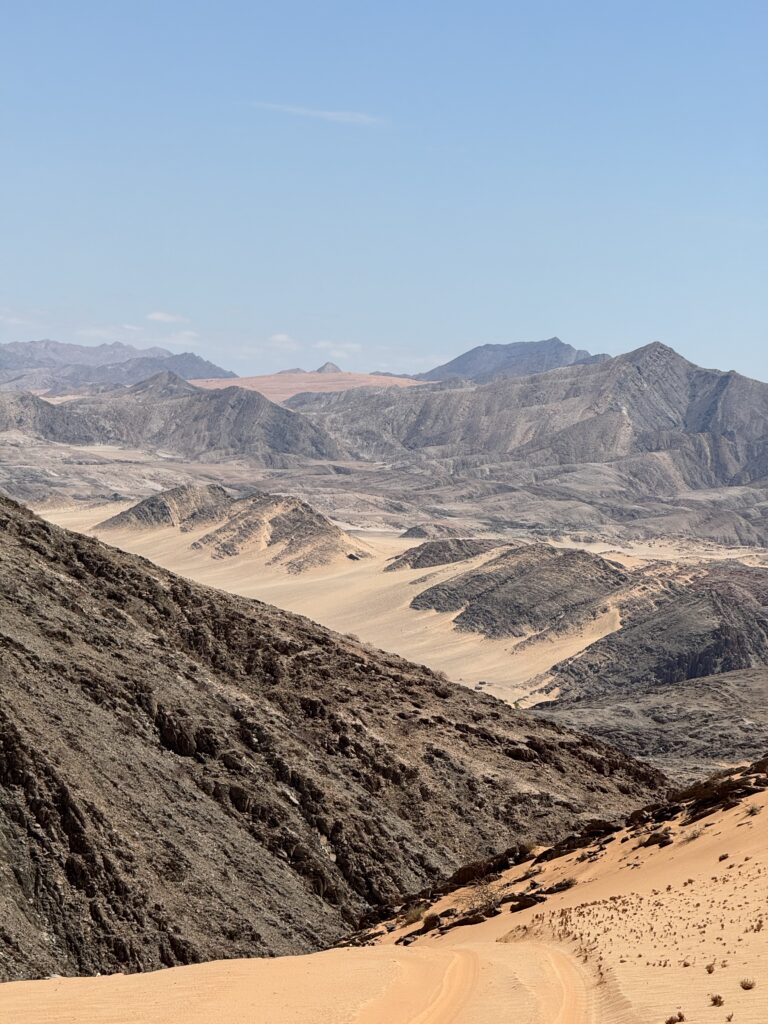
He reveals an impressive trove of knowledge about so many different things; while being able to drive a Land Rover without GPS nor street signs on challenging terrain, in the dark, with poise and confidence.
Trained through a scholarship program funded by the US during the Obama Administration, he remains grateful and acknowledges feeling very lucky to have had this opportunity. One can assume his sponsorship came from USAID.
Needless to say, the program no longer exists.
While still in Cape Town we learned that our US president has already ended all aid to South Africa. Reacting negatively to the suggestion by the South African court that Palestinians in Gaza were victims of genocide. AND (because he feels White South Africans are being unfairly treated by racist Blacks) he has invited White South Africans to come to America as refugees. Some, in his favor, have already immigrated. Others are on their way.

Athon has led us through breathtaking terrain, across the river to Angola, dissected metamorphic rock, introduced us to heretofore unknown species of birds and plants, and revealed The Vally of a Thousand Dunes”. It’s been an amazing educational experience – as we sharpen our lenses and, as he says, “pay close attention to the minor things”.
He has also introduced us to the Himbas. Although Athon said that they had given us permission to photograph them, we refrained. I’m sure that Google has more than enough images and information about this unique tribe.
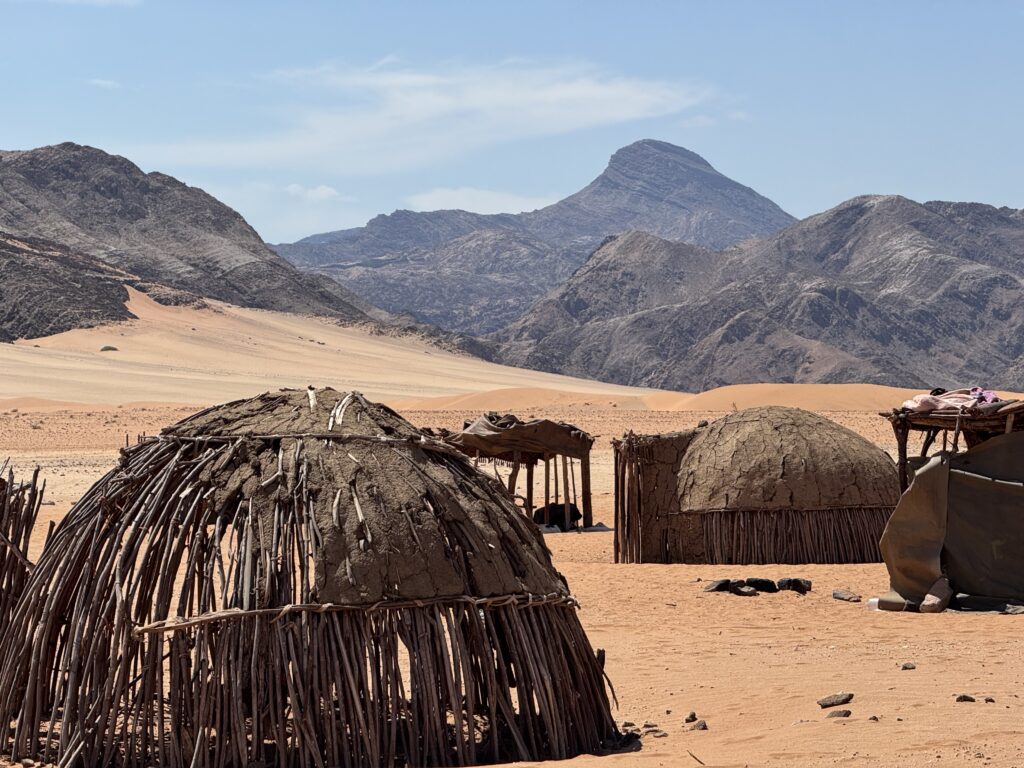
We were able to communicate through interpreters, gestures and pictures on my phone (in retrospect, providing another opportunity to photograph them that passed me by). They asked us questions about our lives, seeming as interested in us as we were of them. Their curiosity, humor and hospitality moved us.
Athon said that what we were observing was not touristic, but how they actually live. Total self-sufficiency. I continued to wonder, how anyone was able to survive with so little and in such harsh conditions. But they do.
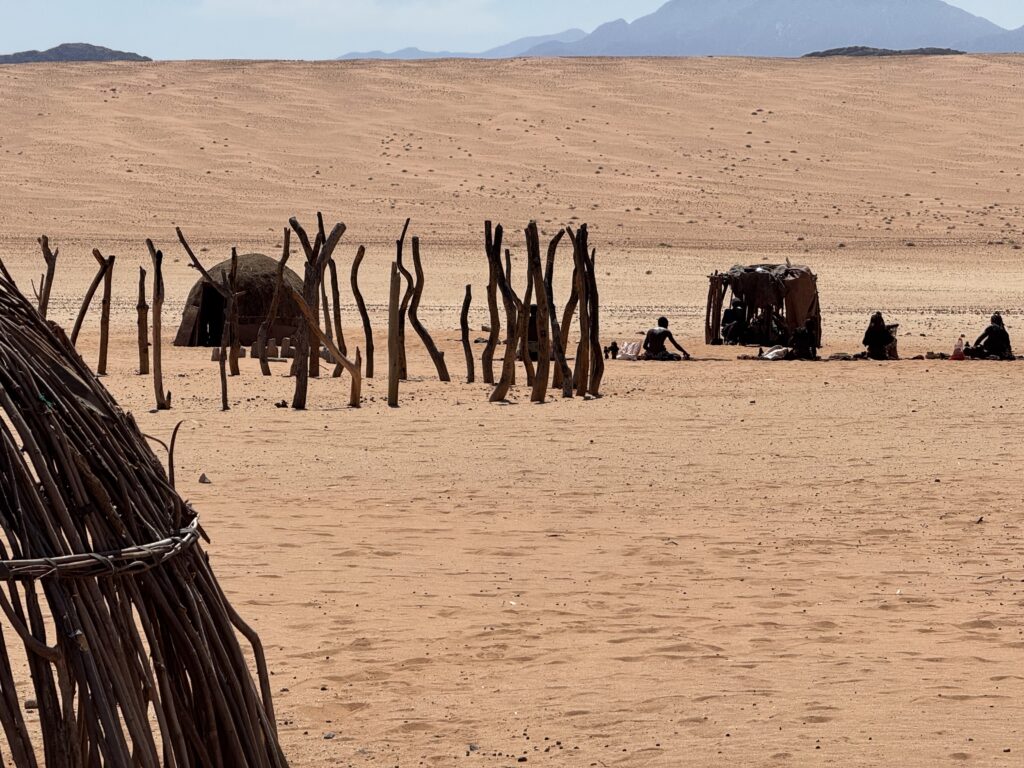
We were interested to learn that the Namibian government has granted them authority over their land. All decisions about possible disturbance of the landscape are ultimately theirs. Consequently, drilling, mining, the development of adventure camps, and water usage has all been strictly and sustainably regulated by them.
Interacting with the Himba heightened our awareness and reminded us further about what we believe to be important in our lives, what is valued, and what is (and is not) essential for survival. For them, it is their animals, water, each other and the land. Land that provides life. Sacred ground that blankets the bodies of their dead.
They have a rich and complex spiritual life. Their ancestors, and the manifestation of spirits through ceremonies around the “Holy Fire” – a sacred space which maintains prominence within their community circle, is inseparable from daily life.
Along the way, we met several people from the tribe walking across the desert – alone in the sand, women carrying loads on their heads, in the absence of roads, signs or flashlights. It was startling to see solitary human figures in colorful dress, against the backdrop of golden dunes and endless desert sand.
The name “Himba” – like so many remnants of colonialism, bares no resemblance to who these people are today. It was given by German settlers and is translated to mean “beggars”. No name could now be further from the truth.